

You can master high-stakes interview skills fast by doing three things. Build a clear personal story, practice answers out loud, and train your nerves before the day. A focused week of smart practice beats months of vague preparation.
High-stakes interviews feel scary because the outcome matters. It might be a scholarship panel, a university admission interview, a competitive internship, or a first graduate job. The pressure is real, but you can manage it with the right plan.
This guide gives you a step-by-step method built for students. You will learn what to research, how to shape your answers, and how to stay calm. You will also get a 7-day plan you can start today.
What Makes an Interview High-Stakes?
A high-stakes interview is one where a single conversation can change your path. Examples include a scholarship panel, a medical school interview, or a final-round job interview. The stakes are high because there are few spots and many strong candidates.
These interviews often share a few features. The panel may include several people. The questions may test your thinking, not only your facts. You may also face follow-up questions that push you to explain your choices.
Knowing this helps you prepare in the right way. Interviewers rarely want perfect answers. They want to see how you think, how you communicate, and how you handle pressure. Good preparation lets you show all three.
Build Your Core Story First
Your core story is a short, honest summary of who you are, what you have done, and where you want to go. Start here, because most questions connect back to it. A strong story makes every answer easier.
Write your story in three parts:
- Past: What shaped your interest in this field or program?
- Present: What are you doing now that proves your interest?
- Future: What do you want to do next, and why does this opportunity fit?
For example, imagine you are applying for an engineering scholarship. Your past might be fixing a broken radio with your uncle. Your present might be a robotics club project. Your future might be designing low-cost medical devices.
Keep the story under 90 seconds when you say it out loud. Then pick three proof points, such as a project, a result, or a challenge you overcame. These become your go-to examples for many questions.
Research the Role, the Panel, and the Organization
Good research shows you care, and it gives you better material for your answers. Spend about 60 to 90 minutes on it, and focus on what you can actually use. Random facts will not help you.
Look at these areas:
- The program or role: Read the official description twice. Highlight the skills and values it mentions.
- The organization: Learn its mission, recent projects, and goals.
- The interviewers: If you know their names, read their public profiles. Look for shared interests, not personal details.
- The format: Find out if it is one-on-one, a panel, a group task, or online.
Next, match your proof points to what they want. If the scholarship values community service, lead with your volunteer work. If the job needs teamwork, share your group project story.
Finally, write three smart questions to ask them. Good questions show curiosity. For example, you might ask what successful students or new hires do in their first three months.
Master the Art of Verbal Interview Preparation
Practicing your responses aloud is the single most effective way to build executive presence, refine your timing, and lock in seamless delivery. While reviewing notes silently builds passive comprehension, it fails to train your vocal inflection or muscle memory under pressure. To project unshakeable confidence when it matters most, you must simulate the real environment by speaking, evaluating your cadence, and adjusting in real time; for a complete roadmap to refining your performance, learn how to master high-stakes interview skills fast with our step-by-step guide.
Use the STAR Method for Experience Questions
The STAR method helps you answer “tell me about a time” questions clearly. It keeps your story short and focused on results. STAR stands for:
- Situation: Set the scene in one or two sentences.
- Task: Explain your role or goal.
- Action: Describe what you did, step by step.
- Result: Share the outcome and what you learned.
Here is a short example. “In my final year, our study group was falling behind on a team project (Situation). I was the group lead, so I needed to get us back on track (Task). I split the work into weekly goals and checked in every Friday (Action). We finished early and earned the top grade in our class (Result).”
Spend most of your time on the action. That is the part that shows your skills.
Prepare for Common Question Types
Most high-stakes interviews use a handful of question types. You can prepare for all of them in advance. Practice at least two answers for each of these:
- Motivation: “Why do you want this?”
- Strengths and weaknesses: “What are you good at, and what do you want to improve?”
- Challenge and failure: “Tell me about a time you struggled.”
- Teamwork and leadership: “Describe a time you worked with others.”
- Problem-solving: “How would you handle this situation?”
For weakness questions, pick a real but manageable weakness. Then show the steps you are taking to improve. Honesty builds trust, and it is more memorable than a fake weakness.
Record Yourself and Get Feedback
Record your answers on your phone and watch them once. You will spot filler words, fast speech, and unclear points. Fix one or two issues at a time.
Then ask a friend, teacher, or career advisor to run a mock interview. Ask them to interrupt you with follow-up questions. This builds the flexibility you need on the day.
Train Your Voice, Body Language, and Nerves
Calm, clear delivery can lift good answers and rescue average ones. You do not need to be a natural speaker. You only need a few simple habits.
For your voice, speak a little slower than usual. Pause for a breath before you answer. A two-second pause looks thoughtful, not weak.
For body language, keep it simple:
- Sit up straight with your feet flat on the floor.
- Make eye contact with the person speaking, and share it with the panel when you answer.
- Use open hand gestures, and avoid crossing your arms.
- Smile when you greet people and when it fits the conversation.
For online interviews, place your camera at eye level. Look at the lens when you speak. Use a plain background and test your sound beforehand.
Nerves are normal, so do not fight them. Try slow breathing before you walk in. Breathe in for four seconds, then out for six. Repeat this for one minute. It helps your body settle.
You can also reframe the feeling. Tell yourself, “I am excited,” instead of “I am scared.” Both feelings feel similar in your body, and excitement helps you perform.
Follow This 7-Day Plan to Prepare Fast
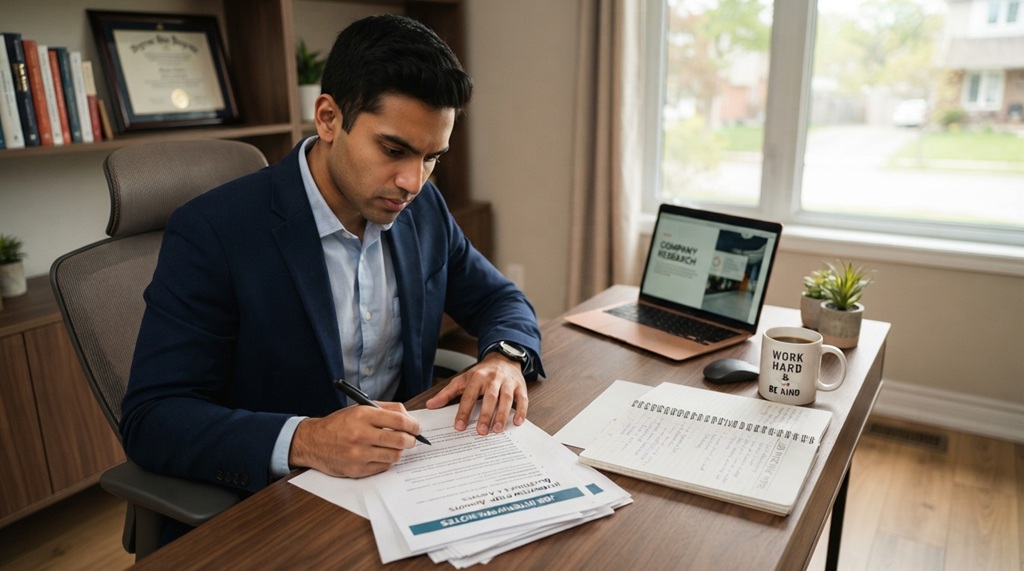
A week is enough time to improve a lot if you practice with purpose. Spend 60 to 90 minutes each day. Adjust the plan if your interview is sooner or later.
- Day 1: Write your core story. Draft your past, present, and future. Choose three proof points.
- Day 2: Do your research. Study the role, the organization, and the format. Write your three questions.
- Day 3: Build your STAR stories. Write four short stories that cover teamwork, challenge, leadership, and success.
- Day 4: Practice out loud. Answer ten common questions. Record at least three of them.
- Day 5: Run a mock interview. Ask a friend or advisor to be strict. Collect feedback.
- Day 6: Fix weak spots. Improve your two weakest answers. Practice your opening and closing lines.
- Day 7: Rest and prepare. Do a light review only. Pick your outfit, check your route or tech, and sleep well.
If you have less time, combine Days 1 and 2, and Days 3 and 4. Never skip the mock interview. It is the closest thing to the real test.
Handle the Interview Day with Confidence
On the day, your goal is to be clear, calm, and genuine. You do not need to be perfect. You only need to be prepared and present.
Arrive 15 minutes early, or log in 10 minutes early for an online interview. Bring extra copies of your resume or documents. Turn off your phone.
During the interview, follow these simple rules:
- Listen fully before you answer.
- Pause if you need a moment to think. It is fine to say, “Let me think about that for a second.”
- Answer the question you were asked, then stop.
- Be honest if you do not know something. Explain how you would find the answer.
- Stay positive when you talk about past teachers, teams, or employers.
If you make a mistake, do not panic. Correct it briefly and move on. Interviewers notice how you recover, and a calm recovery often leaves a good impression.
At the end, ask your prepared questions. Then thank each person and restate your interest in one sentence. Send a short thank-you email within 24 hours. Mention one specific thing you enjoyed from the conversation.
Frequently Asked Questions
How long does it take to prepare for a high-stakes interview?
You can prepare well in about one week if you practice daily for an hour or so. More time helps, but quality matters more than quantity. Focus on your story, your examples, and mock practice.
What is the best way to calm interview nerves?
Slow breathing and practice are the best tools. Breathe in for four seconds and out for six before you start. Mock interviews also help, because they make the real one feel familiar.
How do I answer questions I do not know?
Stay calm and be honest. Say what you do know, then explain how you would find the answer or solve the problem. Interviewers often care more about your thinking than the final answer.
Should I memorize my answers word for word?
No, because memorized answers often sound stiff. Instead, memorize your key points and your STAR stories. This lets you sound natural and adjust to follow-up questions.
What should I wear to a high-stakes interview?
Choose clean, neat clothes that fit the setting. When in doubt, dress slightly more formally than the typical dress code. Pick something comfortable so you can focus on your answers.
Conclusion
Mastering high-stakes interview skills fast comes down to a clear plan. Build your core story, research the role, practice out loud, and train your nerves. Then use the 7-day plan to stay on track.
Your practical takeaway is simple. Today, write your 90-second story and say it out loud three times. That one small step will start building your confidence right away.



Leave a Reply